
Painter, poet, magician and antiquarian, Margaret Ithell Colquhoun (1906-1988) spent her life exploring the avenues of her soul, mapping this otherworld and capturing in her art experiences of the strange forces she encountered there.
Her quest was to remedy that perennial perception of modern humanity a sense of separation from Nature.
This view of Nature was no chocolate box romantic notion rather it was a strange place; perhaps best personified by the Greek god Pan. The task of this early psychonaut was to re-dream the world; to discover a new myth for our time.
Her personal artistic quest took her on an extensive Mediterranean journey early in life but later as she settled in her beloved Cornwall her interior life seemed to find this most independently-minded southern county inexhaustible in its inspiration. There was a profound link which existed between her inner world and the outer physical landscape which allowed the latter to be explored through the medium of her art, through psychology and through magical practices from the Golden Dawn to Aleister Crowley, from Druidism to the eldritch magic of Kenneth Grant's New Isis Lodge.

SCYLLA (1938)
EASTERN PROMISE
Ithell Colquhoun was born 9th October 1906 in colonial Assam; her father being employed in the civil service at Manipur. Ithell was born in the town of Shillong; where Guru Swami Vivekananda, who brought yoga and Advaita Vedanta to the West, gave his last public lecture and where his statue still marks the event.
Born with the Sun in Libra and the Moon in Gemini Ithell Colquhoun may have considered herself well suited to seek equilibrium between two worlds:
“Sometimes I copy nature, sometimes imagination: they are equally useful" [1]
According to her birth chart she had Sagittarius in the mid-heaven, perhaps an indication of her lifetime fascination with higher mysteries, Secret Chiefs and hidden wisdom?
She returned to England as a child being schooled at Cheltenham Ladies College and in 1927 qualified for a place at Slade School of Art in London. Here her artistic abilities were quickly recognised winning first prize for one of her better known paintings - Judith Showing the Head of Holofernes.

JUDITH HOLDING THE HEAD OF HOLOFERNES (1927)
The biblical tale tells how a beautiful Hebrew widow overcame the invading army of Nebuchadnezzar by seducing its general, Holofernes then beheading him when he fell into a drunken sleep. This was a popular theme for pre-20th century artists, most notably Caravaggio, who depicted the moment of decapitation. In Colquhoun's rendition she shows Judith brandishing the Assyrian general's head; in a triumphant scene of feminine sexuality over masculine pride and domination. This theme had a spiritual as well as a political significance for the artist.
After her graduation from Slade she travelled the Mediterranean. Her biographer, Richard Shillitoe, remarks:
“Her destinations included Greece, Tenerife and Corsica. She has written that she studied abroad, but there is no evidence that she followed any formal course of study.” [2]
The continent, however, would prove to be influential on her when in 1931 on her first trip to Paris she was exposed to the work of the surrealists.

THE ARTIST AT WORK
METHODS IN DIVINE MADNESS
Surrealism’s interest in the unconscious, as a source of artistic inspiration, dove-tailed neatly into Colquhoun's abiding fascination with the spiritual realm. Throughout her life she would demonstrate a passionate desire in developing methods to communicate with this world of spirit through the unconscious.
Her methods relied on the practice of automatism in her art and writings, magical techniques and visionary walks called drifting, first developed by the Surrealists and used decades later by the psychogeographers of the Situationist movement. But whereas these later proponents ‘drifted’ to re-imagine urban landscapes Colquhoun sought to contact the genius loci in more rural surroundings.
André Breton, the founder of the Surrealist movement defined his creation as:
“Pure psychic automatism by which it is intended to express, either verbally or in writing, the true function of thought. Thought dictated in the absence of all control exerted by reason, and outside all aesthetic or moral preoccupations.” [3]
The goal for Surrealism was to resolve the contradictions between the conscious and the unconscious, between the rational and the irrational, between Man and Nature – the latter having feminine connotations.

THE ANDROGYNE (1940)
The androgyne is a symbol of this unification of opposites. It is a figure that is central to alchemy; a subject close to Colquhoun's heart. The androgyne, which unites both male and female in one body, was used by the psychologist C.G. Jung as a symbol to signify the possibility of unity within opposition. Colquhoun explored such images in her work. It seemed to her that this split into male and female was a split in the psyche and in dire need of healing. Laying much of the blame at the door of male domination and its one-sided rationalism she sought to redress this balance by exploring castration themes in her art and writing. However this should be seen as remedial only, her ultimate aim was to seek for gender balance.
Although Colquhoun would, in later life, undergo Jungian analysis and involve herself in research into dreams and the unconscious, her interest in representing this inner world went back a long way as her perennial interest in magic and alchemy show.
Like Austin Spare, Colquhoun used techniques of automatism extensively in her work. Although Spare had been using such methods at least a decade before Breton popularised them; it was from France that Colquhoun 'discovered' the technique for herself towards the end of the Thirties.

PHOTOGRAPH showing Ithell Colquhoun (wearing headscarf) on the left with Anne Matta (wife of Chilean artist Roberto) and Gordon Onslow Ford during their stay in Chemilleu.
During the summer of 1939 the artist Gordon Onslow Ford hired a chateau in Chemilleu inviting other artists to come and work alongside him; guests included the Chilean artist Roberto Matta and André Breton whose group Ford had joined the previous year.
Ithell Colquhoun visited during this time joining in with their pastimes of painting and poetry recitals. Matta had been working, since 1938, on a series of “inscapes” by which he sought to evoke the human psyche through visual form.
Colquhoun had been inspired and upon her return to England began experimenting with chance and spontaneity in her own art. Over time she developed the methods she had witnessed as well as creating some of her own: a smudge on a canvas, cracks in a wall transferred to paper by rubbing, “found” objects on long walks, smoke stains and oil on water with paper laid on top to transfer the pattern - all of these were used as adumbrations with the artist then supplying details according to what this ‘prima materia’ might suggest. These objects became the medium for a dialogue with that unseen world through the intermediary world of imagination.

TRITON (1971)
This occult world, which did not follow the categories of waking experience, suggested a place of timeless objects only visible inwardly for which the art provided the medium to the experience. Colquhoun borrowed Matta's phrase 'psychological morphology' to refer to these extended objects expressing the idea in a poem Les Grandes Transparentes:
“They are both here and there, they penetrate all ways
They go both north and south, they are past and to come
They are the profound tilt, the absolute angle
To things that we know.” [4]
OCCULT COLQUHOUN
Surrealist art and its methods of unconscious expression were not Colquhoun’s only attempts to reach out across the divide between the worlds seen and unseen. Neither was she content with rationalistic explanations for what it was that lay within:
“She made extensive use of automatic techniques in her paintings and drawings to make her will subservient to transpersonal forces.” [5]
From an early age Ithell Colquhoun’s interest in the occult had been piqued by perhaps the one occultist of modern times who attracted praise and condemnation in equal measure:
“I was a schoolgirl sitting on a lavatory-seat and leaning forward so as to see into the depths of an osier basket lined with newspapers. The closely-printed pages carried an article written by a young woman visiting an Abbey in Sicily and described the strange goings-on there. The director of the place was someone whom she called 'The Mystic' but did not otherwise identify; and his Abbey was far from being an ordinary monastic establishment…
When I came out of the bathroom my mother took my place there, and she too must have looked into the laundry-basket for she emerged later in a fury… What was the use of a good education if I wasted my talents on preoccupation with the lowest of the low? … [M]y opinion of her intelligence sank to a new low.” [6]

CUCUMBER (1939): The restoration of the Sacred Feminine was explored through images showing the usurpation of masculine domination and castration.
This was Betty May’s account in the Daily Express of the goings-on at the Abbey of Thelema in Sicily under the auspices of its mystic-in-residence Aleister Crowley.
Her occult interests were as wide ranging as they were long:
“Although the Qabalah formed the basis of Colquhoun’s world view, it did not define its limits. An interest in Eastern spirituality, especially Tantra, was, as time passed, combined with earth magic, Celtic lore, Druidism and Wicca.” [7]
Ithell Colquhoun was promiscuous in her appetite for applying to join occult orders - not always successfully. The list includes: The Golden Dawn, Ordo Templi Orientis, Kenneth Grant’s New Isis Lodge, Dion Fortune’s Society of Inner Light, Order of the Keltic Cross, Order of the Pyramid and Sphinx, the druidical order of the Ancient Celtic Church, Order of the Ancient Free and Accepted Masonry for Men and Women and towards the end of her life she ordained as a priestess in the Fellowship of Isis.
One possible reason for her serial membership of occult orders may have been her deep and abiding faith in the Secret Chiefs. These shadowy personages were thought to be highly evolved beings responsible for the spiritual development of humankind. Although a belief in a spiritual hierarchy with active benevolent tendencies towards humanity dates back many centuries it was probably Helena Blavatsky, the co-founder of Theosophy, who brought it to wider public attention in recent history. She, herself, claimed to be in regular contact with the Mahatmas (her name for these beings) and claimed them as a source for her own teachings. Colquhoun, herself, was a long standing member of the Theosophical Society.
The power of claiming intercourse with higher beings was not lost on others who founded orders to spread their own brand of occult teachings. S.L MacGregor Mathers, Aleister Crowley, Dion Fortune and Kenneth Grant all claimed knowledge and conversation with spiritual powers of high pedigree.
However, the tendency for schism and factions within orders and groups meant that ensuring purity of the message was not easy!
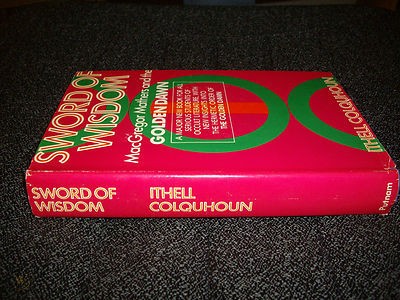
In her book ‘The Sword of Wisdom’ – the biography of Golden Dawn magus S.L. MacGregor Mathers, Colquhoun painstakingly lays out the family tree of British occult orders from the 19th and 20th centuries. She reproduced membership lists tracing the lineage from the Golden Dawn and its influence on other magical orders. Are Ithell Colquhoun’s own multiple memberships an attempt to distil the solar gold reflecting in occult pools no matter how fractured they had become?
One thing does seem certain, she was quite sure that the architect of the Golden Dawn, MacGregor Mathers had a genuine link to this secret and clandestine order of ascended beings.
MacGregor Mathers, was a mixture of Boy’s Own physical prowess and the bookish scholastics of Dr Dee. This potent figure had a profound effect upon Colquhoun. When in 1967 she inherited a portrait of Mathers that she had first seen in the thirties her reaction was of a heartfelt yearning for a long lost love. She described it as the “face of an angel”, kissing the portrait’s lips and weeping. This portrait now hangs in the Atlantis bookshop; in Bloomsbury, London.
Although she joined many orders and seemed to be hunting for a genuine spiritual authority she was not blind to the shortcomings of such orders, their founders or members. Perhaps her wide experience of them made her a particularly good authority on the nature of the beast:
“The basic formula for such establishments is a simple one: get hold of a large house and garden, also a biddable and industrious wife and/or selection of concubines with similar qualities; then collect disciples of both sexes willing not only to pay for their keep but to work for it. (You recommend work in house and garden for its therapeutic value, but it also saves you the expense of employing staff.) The formula was used successfully for a number of years early this century by 'Monsieur Gurdjeff' (sic) at Fontainebleau; by Crowley (more briefly) at his Abbey of Thelema, Cefalu, in the early Nineteen-Twenties and by P.D Ouspensky in the Thirties, when he occupied at least two different properties in the Home Counties. To expand the cynical remark that 'behind every Western teacher is a boarding house or a brothel', I would put Meredith (Starr) and Ouspensky into the first category; but if the reports of inmates are exact, there were at least elements of the second chez MM. Gurdjeff (sic) and Crowley.” [8]
THE LANDSCAPE OF SOUL
The Jungian analyst James Hillman once described soul not in terms of a possession within us rather as something that we move through every day of our lives.
This view is evocatively described by Colquhoun in her book The Living Stones; an animistic hymn to her beloved Cornwall where she spent much of her later life and the county which has inspired so many mystics and artists.

DANCE OF THE NINE MAIDENS (1940): The Cornish landscape in particular spoke to Colquhoun evoking its folklore as a living experience.
“Kaif (from the Arabic) is sometimes used as a term for a certain stage of intoxication produced by hashish - after the hilarity and heightening of sensation have subsided, there supervenes a timeless musing, a direct experiencing of the moment; a wordless, thoughtless vacuum in which one can dwell on the flickering of a fire, the slant of a tree's shadow, the shape of a cloud. Addicts like Poe and Baudelaire have described it; but in order to know it there is little need to call on pharmacy's aid, since it is also one of the stages of artistic creation.” [9]
This state of close connection to and inspiration by the landscape, in this case Cornwall, resulted in a verbal artwork combining elements of geology, flora and fauna, folklore, myths and memory. These “found” objects she would arrange into passages of haunting beauty which would point beyond themselves to strange mysteries.

TARO - ACE OF DISKS
The 1957 publication of ‘The Living Stones’ coincided with her membership of Kenneth Grant’s New Isis Lodge with its Lovecraftian themes – of Elder Races seeking ingress from ‘alien’ dimensions and gateways to the ‘outside’ locked within ancient artefacts or places – some of which seemed to seep into Colquhoun’s writing.
Her exploration of Cornish saints leads her to visit the Church dedicated to St Uny at Lelant where she experiences forces, dark and foreboding.
“The interior of the church, cold, bare and well-kept, yet harbours a feeling that is neither clean nor holy. A miasma from the graveyard seeps through its walls; I hurried out, almost physically nauseated. Here is St. Uny suffocated by alien powers of several kinds.” [10]
Her feeling was that this tip of the county was the special focus for such occult forces which were a-human and probably cosmic in origin.
“An Associate… worked out some astrological charts…These indicated an immense funnel through which strange forces were pouring down into Cornwall's horn. Astrology seems to be right.” [11]
CONCLUSION & LEGACY

IN LATER YEARS
Although Ithell Colquhoun’s work may not well-known to the general public; she is becoming more widely regarded amongst esoteric artists and the pagan community. She is still remembered amongst the artistic community of her adopted county of Cornwall.
Perhaps one of the most obvious legacies of Ithell Colquhoun’s life and work is that she is a rare example of a female occultist and artist. Dr Amy Hale, anthropologist and one-time editor for the Journal of the Academic Study of Magic explains:
"Female occultists are so frequently overlooked and overshadowed by men and in Colquhoun's work we are fortunate enough to see the lifelong record of an exceptional female mage. She was so incredibly ahead of her time, was an outspoken champion of the equality and power of women, and was not afraid to challenge societal norms.” [12]
Dr Christina Oakley-Harrington who runs Treadwell’s Esoteric Bookshop in Bloomsbury London adds:
“I first came across Ithell Colquhoun's art in a library in Belfast… I was arrested by her poetry and drawings - her pagan sensibility was evident, her communion to the Cornish landscape and its spirit. Yet in her work is no sentimentality, it has darkness - starkness even... She is a great woman occultist – a rare enough breed; she was proud, independent, committed to her art, and yet sensuous and emotional. She disrupts the stereotype of the magician -- and indeed the stereotype of the artist -- and I love that.” [12]
For contemporary artist Peter Dyde who also works within an esoteric tradition and shares a similar interest in the process of making art using forms of spiritual communion:
“Ithell Colquhoun had the ability to paint with an energetic stillness. Her paintings have a subtle power inciting the viewer to look within for a higher resolving point.” [12]
The union of opposites is perhaps one theme that is now more urgent than ever. Joseph Campbell wrote that it is the artist’s task to resonate with and express the themes of the age. As her biographer, Richard Shillitoe, says:
“Colquhoun is testimony to the indivisibility of life, art and magic. This is her legacy. Equally at home in contemporary neo-Paganism as in pre-Enlightenment mystical Christianity, her overriding aim was to seek the unity that underlies the world’s apparent diversity.” [12]
With an exhibition that includes some of her works taking place in London in May; perhaps now is the time for her to step out from the shadows. Her message being that the mysteries of the soul have a role to play alongside reason in solving the problems of our world. In fact to discard them is only to emasculate ourselves from a deeper sense of life and communion with Nature.
I:MAGE An inaugural exhibition of esoteric artists; 19-25th May 2013 at The Store Street Gallery, 32 Store St. London WC1E 7BS.
NOTES
[1] Shillitoe Richard, Ithell Colquhoun: Magician Born of Nature. Lulu
2010, p1.
[2] Ibid p2.
[3] From First Surrealist Manifesto by André Breton extracts available here: http://en.wikipedia.org/wiki/Surrealist_Manifesto
[4] Shillitoe Richard, Ithel Colquhoun: Magician Born of Nature. Lulu
2010, p55.
[5] Personal correspondence
[6] Colquhoun, Ithell, The Sword of Wisdom. London, Neville Spearman 1975, p15.
[7] Shillitoe Richard, Ithell Colquhoun: Magician Born of Nature. Lulu
2010, p38.
[8] Colquhoun, Ithell, The Sword of Wisdom. London, Neville Spearman 1975, p25.
[9] Colquhoun, Ithell, The Living Stones. London, Peter Owen, 1957, p27.
[10] Colquhoun, Ithell, The Living Stones. London, Peter Owen, 1957, p60.
[11] Colquhoun, Ithell, The Living Stones. London, Peter Owen, 1957, p133.
[12] From the author’s personal correspondence


